

This year, the UNESCO Institute for Information Technologies in Education (IITE) convened its Governing Board (GB) in Beijing, China, for its 26th Session, held on 20 August 2026 within the framework of the Global Smart Education (GSE2026) Conference.
The meeting was opened by Professor Mohamed Jemni, Vice Chair of the Governing Board, together with Dr. Shafika Isaacs, IITE Director a.i.
In his welcoming remarks, Professor Jemni thanked Beijing Normal University for its warm hospitality and excellent arrangements. He welcomed Dr. Shafika Isaacs in her role as Interim Director of UNESCO IITE and highlighted her extensive international experience in digital learning and artificial intelligence in education that she brings through her concurrent position as Chief of UNESCO’s Section for Technology and AI in Education at UNESCO HQs.
Professor Jemni also welcomed the new members of the Governing Board and noted that the session took place at an important time for IITE and education worldwide, as digital transformation and the rapid development of artificial intelligence continue to reshape education systems. These developments create significant opportunities while also raising important questions related to equity, inclusion, ethics and human agency.

He thanked Professor Asha Kanwar, former Chair of the IITE Governing Board, and Dr Tao Zhan, former Director of IITE, for their leadership and longstanding commitment to the Institute’s mission. Dr Zhan made an important contribution to strengthening IITE, expanding its partnerships, and advancing its international visibility and activities in the field of ICT and digital technologies in education.
The Russian government was represented by Ms. Ksenia Gaverdovskaya, Senior Advisor of the Commission of the Russian Federation for UNESCO, and Ms. Olga Molovtseva, Deputy Director of the Department of the International Cooperation from the Ministry of Science and Higher Education of the Russian Federation. In their statements, they highlighted the Institute’s achievements, offered suggestions for its programme activities, and reaffirmed continued support for IITE. They also noted that the Institute would celebrate its 30th Anniversary next year.
During the session, Dr. Shafika Isaacs presented an overview of the Institute’s activities over the past year. The Unit Chiefs and the Head of the Administrative Office also reported on programme achievements, the financial situation, and priorities for ongoing and planned projects. The Governing Board discussed the reports, adopted relevant recommendations and decisions, and provided guidance on thematic priorities and implementation.
Governing Board members reiterated their commitment to supporting and guiding IITE and commended the results achieved by the Institute and its global partners in supporting Member States, policymakers, teachers, and youth.
The Governin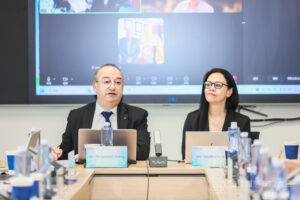 g Board elected Professor Mohamed Jemni as Chair and Professor Didier Jourdan as Vice Chair of the Board.
IITE Governing Board Members also participated in the Global Smart Education (GSE2026) Conference, jointly organized by Beijing Normal University and IITE, contributing as speakers and moderators.
The IITE Governing Board meets at least once a year to define the Institute’s general policy, approve its Programme of Activities and Budget, and provide guidance on its operations.
Governing Board Members are appointed by the Director-General of UNESCO, taking into account geographical distribution and gender balance. They are selected for their eminence in the field and serve in a personal capacity.