

As part of Digital Learning Week 2026 (DLW 2026), UNESCO’s flagship event on digital transformation of education, held at UNESCO Headquarters in Paris from 8 to 10 September, the UNESCO Institute for Information Technologies in Education (UNESCO IITE) and the International Centre for Higher Education Innovation under the auspices of UNESCO (UNESCO-ICHEI) convened a session on “AI and Women’s Leadership in Higher Education: Insights from UNESCO IITE and UNESCO-ICHEI Initiatives”. The session brought together higher education leaders, experts and practitioners from Africa, Central Asia, Southeast Asia and other regions to discuss how women’s AI competencies and leadership can contribute to institutional transformation and more inclusive approaches to AI governance in higher education.

In her opening remarks, Dr Shafika Isaacs, Interim Director of UNESCO IITE, emphasized the persistent underrepresentation of women in leadership and innovation. Noting that women lead only 27% of the world’s top 200 universities and are 13 times less likely to file a patent, she stressed the need to strengthen women’s leadership in shaping the future of higher education. She outlined how the UNESCO IITE–UNESCO-ICHEI partnership has evolved from regional capacity-building in Central Asia to large-scale initiatives focused on AI competencies and digital transformation. She highlighted Women Leading Change in Africa: Future Higher Education Professionals and Leadership in the Intelligence Era, a programme jointly initiated by UNESCO-ICHEI and UNESCO IITE in 2024, which has reached more than 3,000 educators across the continent. Dr Isaacs underscored the need for stronger mentorship networks, gender-responsive learning opportunities and institutional support to help women lead change in the AI era.
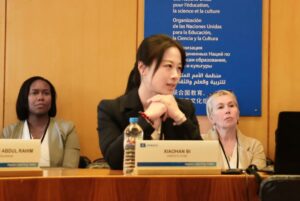
Building on these reflections, Ms Bi Xiaohan, Deputy Director of UNESCO-ICHEI, presented an overview of the Women Leading Change in Africa programme and its approach, which combines digital and AI competency development, leadership capacity building, institutional transformation and knowledge exchange through the International Institute of Online Education (IIOE) ecosystem. She highlighted three lessons from the programme’s implementation: the importance of local mechanisms for delivering global initiatives; the greater impact that can be achieved through institutional networks; and the need to embed capacity development in institutional policies and structures to ensure lasting impact.
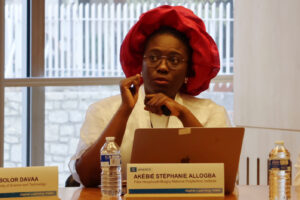
Practitioners from participating institutions illustrated how these principles are being applied in different national and institutional contexts. Dr Akébié Stéphanie Allogba of the Félix Houphouët-Boigny National Polytechnic Institute (INP-HB), Côte d’Ivoire, presented her institute’s experience in implementing the pilot. She covered outreach and registration, access to five AI and digital pedagogy micro-certifications, monitoring of course completion and certification, and preparation for subsequent institutional activities and expansion.
Dr Dalia Yousef, Director of the Central eLearning Unit at the Education Strategies and Research Centre of Ain Shams University and Head of the IIOE Egypt National Centre, reported that more than 4,000 faculty members had strengthened their competencies through dedicated micro-certification programmes, with women accounting for 66% of participants. The certificates are recognised by university leadership and count towards academic promotion. Contributions from Ethiopia, Nigeria and Zambia further demonstrated how the programme is being adapted to different institutional environments and delivery mechanisms.

The session also brought perspectives from outside Africa. Datuk Dr Habibah Abdul Rahim, Director of the SEAMEO Secretariat and Head of the IIOE Southeast Asia Regional Centre, highlighted the importance of measuring changes resulting from capacity-building initiatives, ensuring that women participate in decision-making, and strengthening connections between regions through peer learning, joint research and knowledge exchange. From Central and South Asia, Prof Ariunbolor Davaa of the Mongolian University of Science and Technology and Prof Chitra Bahadur Budhathoki of Tribhuvan University in Nepal shared approaches to localising AI learning, strengthening mentoring and leadership opportunities for women, and connecting AI and digital skills with research, professional development and institutional leadership.
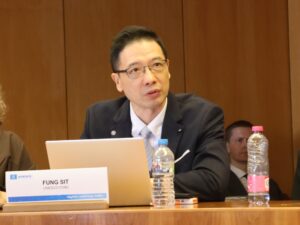
Building on Women Leading Change in Africa, Mr Fung Sit, Assistant Director of UNESCO-ICHEI, and Ms Tatiana Murovana, Project Officer in Education at UNESCO IITE, presented a proposed next phase of cooperation: AI-Enabled Empowerment: Women’s Leadership in Higher Education in the Global South. It would extend the insights gathered in Africa to a broader range of regions, including Central Asia, Southeast Asia, the Arab States, and Latin America and the Caribbean. The initiative would combine four areas of action: blended capacity building, through hybrid training workshops for women faculty and academic leaders; open educational resources, including gender-responsive AI courses, teaching guides and AI governance toolkits made available through the IIOE platform; cross-regional peer learning, through virtual communities and policy dialogues across Global South regions; and knowledge production, by documenting and sharing local good practices to inform global policy discussions and research.

The session reflected wider discussions at DLW 2026 on the need for education systems to develop the capacity to shape and govern AI in line with educational priorities, human agency and local contexts. Throughout the DLW, ministers, academics, practitioners, international organisations and technology experts examined questions ranging from AI governance and digital sovereignty to learner safety, procurement and the changing role of educators. These discussions underscored the importance of strengthening institutional capacity and ensuring that decisions about AI remain aligned with the public purposes of education.