
 Nearly 400 participants from over 25 countries gathered in Hanoi, Viet Nam, for the 2026 Global MOOC and Online Education Conference (GMC 2026), reaffirming the importance of MOOCs and online education in the age of artificial intelligence. Co-organised by the Global MOOC and Online Education Alliance (GMA) and UNESCO IITE, and hosted by Tsinghua University and Vietnam National University, the conference was held under the theme “Reallocating Intelligence: Transforming Education for a Human–AI Future”. Discussions explored how advances in AI are creating new opportunities for the design, delivery and personalisation of MOOCs, while reshaping online learning and the wider higher education landscape.

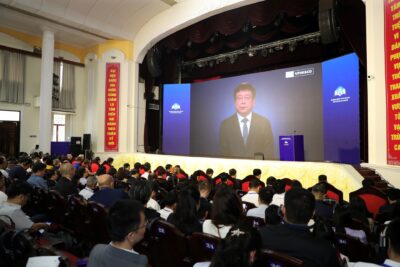
The opening ceremony on 3 November featured remarks by His Excellency Le Tien Chau, Deputy Prime Minister of Viet Nam, who underscored the role of higher education in developing high-quality human resources and advancing innovation, while calling for responsible, human-centred AI and stronger international cooperation. Prof Tshilidzi Marwala, Rector of the United Nations University and UN Under-Secretary-General, stressed the importance of global cooperation in ensuring that technological progress serves humanity and that the benefits of AI-infused education are shared by all. In a video address, Mr Chen Qun, UNESCO Assistant Director-General for Education, underscored UNESCO’s commitment to reimagining the future of universities and building a more open and interconnected global education ecosystem, with human needs and values at its heart. He highlighted UNESCO IITE’s role as a member of GMA and co-organiser of the conference since its launch in 2020.
Dr Shafika Isaacs, Interim Director of UNESCO IITE and Chief of Section for Technology and AI in Education at UNESCO, delivered a keynote address on the role of higher education in the age of AI. Drawing on UNESCO’s vision of education as a human right and a common good, she emphasised that AI in education must serve the public interest, be shaped through public participation and remain subject to public accountability. Her remarks echoed the principles set out in the Ministerial Statement adopted at UNESCO Digital Learning Week 2026, reaffirming the need to safeguard the public purposes of education amid technological transformation.

The conference also featured the GMA Awards 2026 which recognise outstanding MOOCs developed by higher education institutions and organisations worldwide. The 20 award-winning courses span a wide range of disciplines and applications, from data structures and algorithms to AI literacy for educators and AI-powered student support systems. The winning entries demonstrate the breadth of innovation in online education, including the use of AI to support personalised learning experiences and new forms of learner support.
The conference programme featured four plenary sessions and a series of roundtable forums addressing key priorities for the future of higher education. Discussions examined how universities and online education providers can rethink their strategies, teaching practices and institutional models in response to the growing capabilities of AI. Topics included the development of future-ready universities, new competencies for educators and learners, and approaches to AI governance, ethics and trust. Participants also considered how AI can support innovation in teaching and learning across different professional and disciplinary contexts, alongside opportunities for digital resource sharing and stronger regional cooperation.

Ms Tatiana Murovana, Project Officer in Education at UNESCO IITE, delivered welcome remarks at the China–ASEAN Workshop on Artificial Intelligence and Digital Education, held as part of GMC 2026. The workshop brought together experts and practitioners to exchange regional experience and explore the application of AI in teaching innovation and professional education, as well as opportunities for cooperation in digital education.
Launched by UNESCO IITE and Tsinghua University in 2020 during the COVID-19 pandemic, the Global MOOC Alliance brings together universities and online education platforms from around the world to promote international cooperation, knowledge sharing and innovation in digital education. Through its continued engagement with GMA and the annual GMC conference, UNESCO IITE supports dialogue on the evolving role of MOOCs and online education and their contribution to the transformation of higher education.


