Combating COVID-19: Updates

How to prepare for the reopening? IESALC recommendations for how to transition towards the new normal in higher education

28 May 2020

The Institute suggests to higher education institutions that they follow a 3 – Phase Plan: distance teaching continuity; resumption of face-to-face teaching activities respecting health protocols and restructuring teaching models to create a hybrid one which includes classroom and virtuality. IESALC also calls on States and Institutions to give priority attention to the lack of equipment and connectivity; and ensure connectivity. (UNESCO IESALC)

Collecting essential education data during the Covid-19 crisis

22 May 2020

Statistical institutes in low- and middle-income countries face significant pressures to collect education data under quarantine. Given the difficulties imposed by the Covid-19 crisis, the basic questions for ministries of education, their agencies and statistical institutions are: (i) what data to collect, and (ii) how to collect it, to monitor learning equity. These questions, along with others, are discussed in the article. (World Education Blog)

Flexible learning during Covid-19: how to ensure quality higher education at a distance

21 May 2020

The Covid-19 outbreak closed universities and other tertiary education institutions in 175 countries, affecting over 220 million post-secondary students. Some institutions moved their classes to online and distance education platforms thanks to their pre-existing experience, but many others struggled. In some countries, this lack of preparedness resulted in delays in moving the courses online; in others, governments have halted higher education completely for an indefinite period of time. (World Education Blog)

Over 500 million of the world’s children and youth not accessing distance learning alternatives

21 May 2020

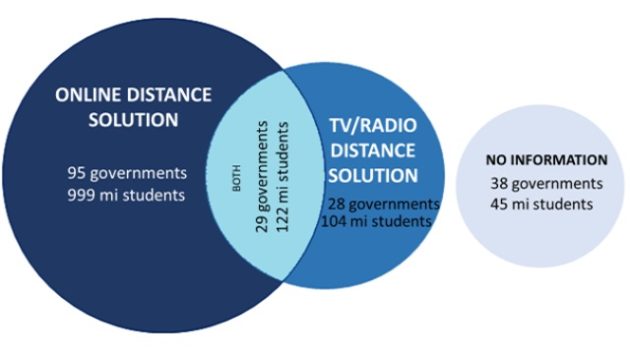
Since February 2020, school closures in 190 countries have caused widespread disruption of the education of 1.27 billion children and youth or some 95% of primary and secondary students worldwide. While governments in four out of five countries with school closures have proposed national distance learning alternatives in efforts to ensure continuity of curriculum-based study and learning, other countries have not. (World Education Blog)

Agencies call for a global push for school health and nutrition

20 May 2020

For the first time since the launch of the Sustainable Development Goals (SDGs) in 2015, UN and multilateral agencies from across health, education, agriculture, WASH, and social welfare sectors have come together to make a renewed commitment to school health and nutrition. (UNESCO)

Students, teachers and parents of UNESCO’s associated schools share COVID-19 experiences

19 May 2020

Over 620 members of UNESCO’s Associated Schools Network (ASPnet) from 80 countries came together to share their experiences of learning and living in confinement, in a webinar organized on 12 May 2020, organized in collaboration with UNESCO IITE. Mirroring global educational disruption, 95% of schools belonging to this network of 12,000 member schools in 182 countries are closed. The webinar was the first of its kind for the ASPnet community, UNESCO’s largest network, in its 65 years of existence. (UNESCO)

UNESCO gathers National Commissions for an Online Meeting on COVID-19

18 May 2020

The National Commissions for UNESCO joined the first Online Meeting on COVID-19. The main objective of this meeting was to discuss with the National Commissions key initiatives launched by UNESCO to respond to COVID-19 and key activities initiated by National Commissions at national level. (UNESCO)

UNESCO’s top tips for studying in lockdown – in one short video

15 May 2020
The coronavirus pandemic has closed schools, colleges and universities around the world. More than 1.5 billion students in 189 countries, including over 45 million in Eastern Europe and Central Asia, were forced to study from home. The transition to distance learning has become a real challenge for teachers and parents, and for many students it also seemed very difficult. Top tips on how to support them in this complicated period are summarized in a short video from the UNESCO experts.

Reopening schools: When, where and how?

15 May 2020

It has been around two months since schools closed in more than 190 countries, affecting 1.57 billion children and youth – 90% of the world’s student population. According to UNESCO data, 100 countries have not yet announced a date for schools to reopen, 65 have plans for partial or full reopening, while 32 will end the academic year online. For 890 million students however, the school calendar has never been so undefined. (UNESCO)