Combating COVID-19: Updates

UNESCO produced graphics on media and information literacy to counter disinformation on COVID-19

12 May 2020

UNESCO released a series of visual and graphic messages on media and information literacy (MIL) for educators, parents and students. The produced materials are meant to contribute to the development of MIL skills and promote best practices to critically analyse information and to navigate through the overwhelming amount of news and headlines on the virus. The materials are available in six languages: Arabic, Chinese, English, French, Russian and Spanish. They are open access and free to be used, downloaded and shared.

Empowering students with disabilities during the COVID-19 crisis

8 May 2020

The article discusses such issues as educational needs for students with disabilities amid COVID-19, barriers to education through remote-learning practices, government suggestions to improve learning processes and outcomes of students with disabilities during a crisis. In order to ensure that systematic, long-term solutions are provided, all factors that affect access to education, including policy, legislation, financing, human resources and data, must be explored. (UNESCO Bangkok Office)

Schools are more than just a platform for knowledge, UNESCO webinar highlights

8 May 2020

The seventh in a series of UNESCO COVID-19 Education Response webinars, it looked at how education and health sectors can apply evidence-informed actions to promote and protect the health and well-being of students. The webinar looked at the range of health and well-being challenges which have emerged in countries across the world. Some of the most vulnerable students bear the greatest impacts, especially girls, with the COVID-19 pandemic highlighting the ever-increasing socio-economic gap between learners. (UNESCO)

Another COVID-19 Front line: Parents of children with disabilities

8 May 2020

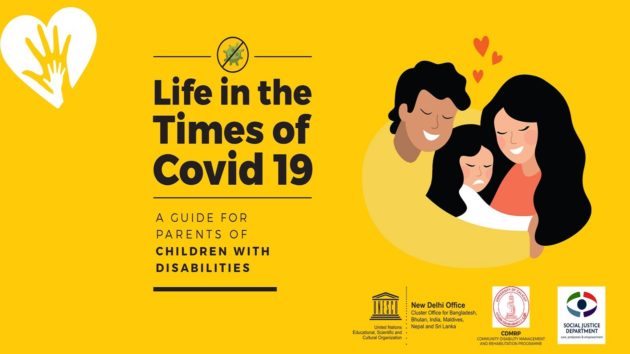
UNESCO New Delhi and the UNESCO Chair in Community Management of Disabilities (University of Calicut) are proud to launch a booklet, entitled Life in the Times of COVID-19: A Guide for Parents of Children with Disabilities. The guide explains and illustrates the different aspects that a parent/caregiver must take into account while taking care of children with disabilities. It also addresses the need to maintain the mental health of such parents/caregivers and their various duties and responsibilities, during these unusual times. (UNESCO)

School, Family and Health Care: 3 pillars to guarantee educational inclusion and equity

7 May 2020

UNESCO International Educational Planning Institute (IIPE-Buenos Aires) organized an online discussion on the relationship between the school, family and health care to reduce the effects of COVID-19, on 29 April 2020. The pandemic will undoubtedly have an impact on equity and inclusion in education. The fundamental role of educational planning in mitigating these potential adverse effects was also addressed. (UNESCO)

1.3 billion learners are still affected by school or university closures, but educational institutions start reopening around the world

7 May 2020

UNESCO has published its most recent figures for out-of-school children, as schools reopen progressively across the globe. As of mid-April, 1.5 billion children and youth were affected by school closures in 195 countries, from pre-primary to higher education. While this figure is dropping, 1.3 billion learners in 186 countries are still unable to attend school. Of the 195 countries that had closed schools in April, 128 have yet to announce plans for their reopening. (UNESCO)

UNESCO IITE took part in TEDx Online Conference: Chronicles of the Future

6 May 2020

On April 30, a five-hour TEDx intellectual marathon took place under the title: Chronicles of the Future. My new world: instructions for use. Ten prominent speakers from four countries shared their visions of the future with the audience. Among the speakers was Tao Zhan, Director of UNESCO IITE. The event also brought together high-level experts in the field of media, marketing, IT, ecology and business. They addressed emerging issues such as digital competence of children and parents, new patterns of consuming content online, the development of career paths in the new reality, the use of artificial intelligence and possible “competition” with robots, as well as the environmental prospects of humankind in the 21st century.

Education ministers share plans for the reopening of schools after COVID-19 closures

6 May 2020

Even if most governments have not set dates to reopen their schools, they are planning for a phased approach that places priority on health, safety and remedial learning, in measures presented by education ministers during an ad-hoc virtual meeting convened by UNESCO on 29 April 2020. According to UNESCO’s monitoring, 71 countries have already announced when schools will reopen. Out of these, 12 have reopened schools, 52 have set the date for reopening during this academic year and seven plan to reopen in the next one. (UNESCO)

New guidelines provide roadmap for safe reopening of schools

6 May 2020

UNESCO, UNICEF, WFP and World Bank issued new guidelines on the safe reopening of schools amidst ongoing closures affecting nearly 1.3 billion students worldwide. The guidelines caution that the widespread closures of educational facilities in response to the COVID-19 pandemic present an unprecedented risk to children’s education and wellbeing. The guidelines offer practical advice for national and local authorities on how to keep children safe when they return to school. (UNESCO)

UNESCO survey highlights measures taken by countries to limit impact of COVID-19 school closures

4 May 2020

A UNESCO survey of national education systems undertaken in 61 countries is shedding some light on the measures being put in place to minimize the impact of school closures due to COVID-19 that has now impacted over 1.5 billion students. The survey indicates that governments around the world are making efforts to rapidly deliver distance education at scale in an attempt to ensure continuity of learning. (UNESCO)

Back to school: Preparing and managing the reopening of schools

30 April 2020

To support Member States in this politically sensitive and charged decision, UNESCO organized its sixth Covid-19 education response webinar on 24 April around effective strategies to anticipate and prepare for this critical transition, sharing lessons also from past crises. The health, safety and overall well-being of students and the entire education community was the central concern expressed by all speakers. (UNESCO)

International Institute of Online Education (IIOE) Kicked off COVID-19 Response Training Series to Address the Pandemic

29 April 2020

On 7 and 16 April, International Institute of Online Education (IIOE) successfully launched its COVID-19 Response Training Series with two webinars, titled “Using ZOOM to Deliver Effective Virtual Lectures” and “Course development strategies to convert face-to-face resources into an online course” respectively. Both sessions have attracted faculty members from developing countries in Asia and Africa, providing practical experiences to address educational disruption during the pandemic. (UNESCO-ICHEI)