

Persons with disabilities remain among the most marginalized groups globally, particularly within education systems. UNESCO is committed to advancing educational equity, equality, and inclusive access for all.
The co-hosted by IITE and CCNU online webinars were organized within the framework of the UNESCO-CCNU project “EmpowerEd: Enabling Inclusive teaching and learning through ICT and AI-Driven Solutions” and in the framework of UNESCO IITE flagship webinar series ‘Harnessing Technology to Transform Education’.
On 19 November 2025, UNESCO IITE convened the first webinar with the aim to highlight best practices from several countries demonstrating how technology, artificial intelligence (AI), and information and communication technologies (ICT) can support learning, communication, and participation for neurodiverse learners, particularly those with autism, ADHD, and specific learning difficulties.
The event brought together over 100 participants and engaged experts from diverse regions, representing both research and practical sectors in education and inclusion.
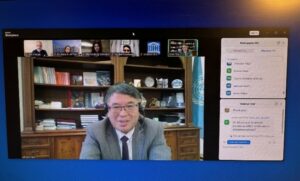 Dr Tao Zhan, Director of the UNESCO IITE, speaking at the event, emphasized: “Inclusion, especially disability inclusion, is a priority for UNESCO’s strategy. We focus on the goal of human–centered and ethical use of AI and digital tools. This approach must be augmented by evidence–based research to show how AI can support disability inclusion in education.”
Dr May Agius, who led UNESCO IITE study Use of AI and ICT to Support Inclusion of Learners with Autism, ADHD, and Learning Difficulties: From Innovation to Inclusion, underlined that many children with neurodevelopmental differences remain excluded from meaningful learning participation. She highlighted that teachers often lack training, tools, or confidence. AI and ICT can bridge these gaps if designed and implemented inclusively. A guiding principle from the study, “Technology does not replace inclusion; it enables it”, underscores the need for thoughtful implementation.
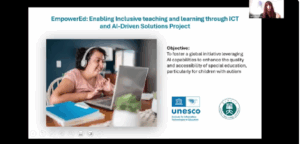
The second webinar held on 27 November 2025 gathered over 60 participants to discuss how inclusive education can be scaled up through the policy, sustainable infrastructure, systemic innovation and equitable provision. The webinar was opened by Dr Natalia Amelina, Chief of Teacher Professional Development and Networking (TPDN) section of the UNESCO IITE who noted that while modern technologies can foster inclusion in education, several barriers still exist. The lack of accessible digital infrastructure for people with disabilities limits their educational, employment, and social opportunities.

Central China Normal University (CCNU), a close collaboration partner of UNESCO IITE, was represented by Professor Jingying Chen, who delivered welcome remarks during the first webinar and underscored the importance of international cooperation in advancing inclusive education with AI supported education tools. Assoc. Prof. Li Rui contributed to the second webinar with a presentation of the best practice Star Future-A Human Computer Interaction-Based System for Evaluation and Intervention of Children with Special Needs.
________________________________________________________________________________________________________________
For more information, please see:
Webinar 1 recording
Webinar 2 recording
Presentations
Webinar 1: Use of AI and ICT to Support Inclusion of Learners with Autism, ADHD, and Learning Difficulties. From Innovation to Inclusion: What Works in Practice
1. Inclusive classroom implementation of literacy supports. Sharon Borg Schembri Assistive Technology Consultant Occupational Therapist, Malta
Inclusive Classroom Implementation of Literacy Supports_Sharon Borg Schembri
2. Therapist-technologist collaboration in robotics-assisted learning. Dr Paulina Tsvetkova, Institute of Robotics, Bulgarian Academy of Science, Bulgaria
Therapist-technologist collaboration in robotics-assisted learning UNESCO webinar_Paulina Tsvetkova
3. MARVok application. Vocabulary Learning using Augmented Reality for children with Autism. Dr Dena Al-Thani, Associate Professor, A-sense Center of Excellence, College of Science and Engineering Hamad Bin Khalifa University, Qatar
UNESCO-MARVoc_Dena A. Al-Thani
4. Using Mainstream Applications to Support School Wide Digital Note Taking. Chrostopher Burgaj, Assistive Technology Specialist for Loudoun County Public Schools, US
Using Mainstream Applications to Support Schoolwide Digital Notetaking – Christopher Bugaj
5. Use of AI and ICT to Support Inclusion of Learners with Autism, ADHD, and Learning Difficulties. From Innovation to Inclusion: What Works in Practice. May Agius, UNESCO IITE Research Consultant
Webinar 2: Use of AI and ICT to Support Inclusion of Learners with Autism, ADHD, and Learning Difficulties. Systemic Innovation: Policy, Place & Provision
1. Star Future – A Human-Computer interaction-based system for evaluation and intervention of Children with special needs. Assoc. Prof. Li Rui, CCNU, China
Star Future_Rui Li_Central China Normal University
2. Ozim Platform – DPG for Families & Educators. Assem Tazhiyeva, Founder of Ozim Platform & Ozim Academy, Kazakhstan
3. Human-Centered Approached to AI: Supporting Neurodivergent Minds in the Classroom Human-Centered Approach. Craig Smith, Australia
4. Press B to Belong: Using collaborative gaming as a space for neurodiversity affirming social inclusion, Assoc. Prof. Matthew Harrison, University of Melburn, Australia
Matthew Harrison – UNESCO webinar 2025 (1)
5. From IT to AT to AI – Building Systems for Inclusion. David Curran. UK
From IT to AT to AI – Building Systems for Inclusion
6. Use of AI and ICT to Support Inclusion of Learners with Autism, ADHD, and Learning Difficulties. Systemic Innovation: Policy, Place and Provision. Dr May Agius, UNESCO IITE Research Consultant